

Why your roots matter so much
The Five Dimensions
of Genealogy
What draws people to family history? What motivates millions of people to take DNA tests, spend countless hours researching distant relatives they have never met, or even travel halfway around the world to walk in the footsteps of their ancestors? Consider the Mayflower Steps in Plymouth, England, where thousands upon thousands of descendants have stood to remember the journey their ancestors began more than 400 years ago.
Surely genealogy is about far more than simply collecting names and dates or keeping family records.
This became especially clear to me when my twelve-year-old son asked why our family history means so much to me. His question made me stop and think. After all, I can spend hours researching a single family line and still find myself shouting "Hooray!" when I discover a new ancestor. There is no denying that genealogy has become much more than an interest—it is something I care about deeply. The more I thought about his question, the more I realised that genealogy is not just an activity. It has many different facets, each appealing to people for different reasons. In the following pages, I'd like to introduce what I see as the five dimensions of genealogy. There may well be others, but these are the five that, in my experience, most family historians will recognise in themselves.

Map showing the migration pathways of Daniel's ancestors between the 18th and 20th century. The blue lines represent his paternal side, the red ones his maternal side.

A typical chromosome painting representative of Germanic roots, showing North Sea/Baltic (yellow) and Caucasus (green) DNA signals

A chromosome painting showing DNA segments associated with Native American ancestry. These segments are often accompanied by signals classified as Asian (orange), Siberian (bright green), and Oceanian (olive), reflecting the ancestral populations involved in the migration of the first peoples into the Americas via the Bering Land Bridge from Siberia.
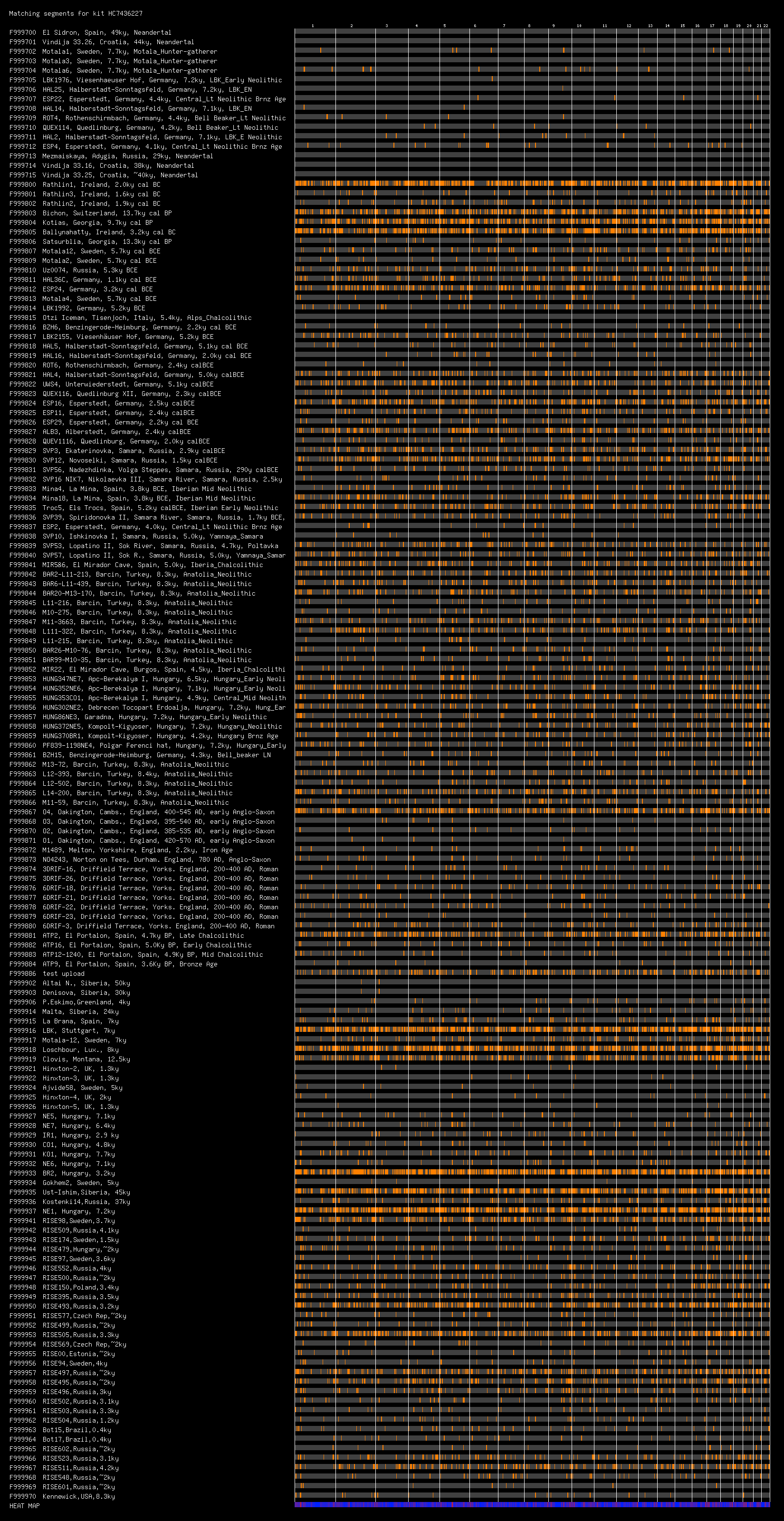
Comparison of DNA with ancient DNA samples recovered through archaeology. (Click to enlarge.) In this example, the tester shows genetic matches to the Clovis and Kennewick specimens, two ancient individuals from North America associated with the earliest Native American populations. The tester also shares DNA with numerous ancient individuals from archaeological sites in present-day Hungary, Germany, Ireland, and England.
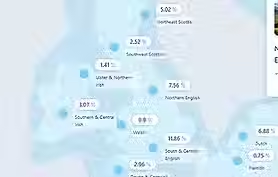
Advanced analysis of DNA origins for the Northwestern Europe region using Genomelink, providing a more detailed picture of ancestral origins and geographic connections.

3D chromosome browser to investigate DNA match triangulations between a group of 8 persons with roots to the Stewart family in Scotland

Sarcopahgus of Hugh de Courteney at Powderham Castle. He was my 19th grandfather on my mother's side.

My son at the Mayflower Steps in Plymouth UK, 2025
From passion to profession -
my own pathway to genealogy
I inherited the beginnings of our family tree from my late uncle in 2016. At the time, it contained around 200 people, reaching back an average of four generations from me, but only covered my mother's side of the family. On my paternal side, only a few handwritten notes and diagrams were available, not much at all. It was a good start, but it also sparked a curiosity that has never really left me.
Could I extend my family tree beyond the few generations that were already known? Could DNA testing confirm what our family had always believed about our ancestry? And was there any truth to the long-held family story that my father's maternal family belonged to the German nobility because their surname included the word "von"? What began as simple curiosity soon developed into a passion that has occupied me for several years.
During my first year, I focused on three goals: expanding my family tree using several online genealogy platforms, confirming each of my eight great-grandparents through DNA evidence, and investigating the family's supposed aristocratic origins. After only twelve months, my family tree had already grown to around 2,000 people. My French lines had been traced back to the eighteenth century and to the family's origins in France. Almost every branch had been extended by several generations, and seven of my eight great-grandparents had been independently confirmed using DNA.
The remaining great-grandparent, however, became one of the biggest challenges of my genealogical journey. Not a single significant DNA match supported the documented identity of my maternal grandfather's father. None of the expected surnames appeared among my matches. None of the expected places appeared either. Instead, I found hundreds of DNA matches living in the United States, together with an unexpectedly large number of more distant matches in England. At first, none of it made sense.
That mystery eventually became a project of its own. Over the following years, I compared documentary evidence with DNA results from multiple testing platforms, gradually building clusters of related matches and learning to use DNA triangulation to identify shared ancestral couples. Large DNA matches provided the first clues, but it was often dozens of smaller matches that confirmed the picture. Today I have around 300 significant DNA matches who all descend from ancestors shared with this American great-grandfather. Piece by piece, they allowed me to reconstruct his family and identify him as an American born in Michigan, whose roots reached back to the early English settlers of Massachusetts and colonial Virginia.
Along the way, I also discovered that the family lore about German nobility on my father's side was simply that—a family story. The word "von" in the surname did not indicate aristocratic status but merely meant "from" a particular place, in this case a tiny settlement in Belarus near the Lithuania border. It was a valuable reminder that genealogy is about following the evidence, not confirming family legends.
Curiously, the opposite proved true on my mother's side. As I pushed further back through the centuries, several maternal and paternal branches entered families that had left an unusually rich historical record in the 12th to 16th centuries, and whose names can be found in European history books. One of them is the Courtenay family, which originated in France and intersects many branches of medieval European aristocracy in German, France, England, Scotland, Ireland and Hungary. My own line descends from Peter II de Courtenay (1155-1217).
As my research continued, a much bigger picture began to emerge. My family history turned out to be one of constant migration. French ancestors moved from the Yonne region into Germany during the eighteenth century. Finnish families migrated through Sweden and Estonia before settling in northern Germany. English ancestors crossed the Atlantic to Virginia, Connecticut, and Massachusetts centuries before one of their descendants, my elusive great-grandfather, eventually found his way back to Europe—and, somehow and somewhere, amidst the turmoil of the First World War, met my German great-grandmother. No recorded marriage or fatherhood. But DNA doesn't lie.
On my father's side, a completely different picture emerged: one of stability, of continuity. The family settled in East Prussia as early as the thirteenth century after migrating from the Netherlands and Rhineland-Palatinate, where some ancestors were recorded as knights.
The research also taught me that family names evolve just as families do. Regnard became Renard, Herminger became Hermigier and later Heermeyer, while Bigge eventually became Biggs. Small changes like these often became important clues in solving much larger genealogical puzzles.
Close to ten years after I took over from my uncle, my family tree now contains more than 25,000 people, including approximately 8,000 direct ancestors. My deepest documented lineages stretch from Germany into medieval Armenia before branching towards northern India and along the ancient Silk Road into China. What I once assumed was a largely German family has become a remarkable mosaic of German, Dutch, English, French, Finnish, Swedish, Estonian, Lithuanian, Belarusian, Scottish, Welsh and many other ancestral origins.
Some discoveries still make me smile. One unexpected line led to Athon de Courtenay, founder of the medieval Courtenay family of France and later Devon in England. That documented lineage later qualified me for membership of the Courtenay Society at Powderham Castle in Devon, where I visited with my son in late 2025. It's a pleasing reminder that family history sometimes leads to unexpected places. Once a year I am now invited to a get-together with the Earl of Devon, a distant cousin of mine, at stunning Powderham Castle in England. I visited together with my son in 2025 and we were amazed by the history on display in the castle - history that connects directly to him and me as direct descendants of some of the people who once inhabited it.
Other discoveries were more thought-provoking. I found direct ancestors fighting on opposite sides of medieval wars, while others unknowingly carried their family lines across continents before eventually converging in Germany. And perhaps most touching of all was discovering that, although my maternal grandfather never knew his American father, they nevertheless shared remarkable talents and interests. Genetics had quietly passed on much more than physical characteristics.
Perhaps the greatest lesson genealogy has taught me is this: if just one of those 8,000 direct ancestors had not survived, had chosen a different partner, or had never had children, I would not exist. Every one of them, whether famous or forgotten, wealthy or poor, was indispensable.
Genealogy has taught me far more than names and dates. It has shown me that every family is the product of countless journeys, migrations, coincidences, hardships, and choices stretching across hundreds of years. My own family is no exception—and that, more than anything else, is what continues to fascinate me.
Article by Daniel Arnold
on the topic of Post-War Migration
published by the Australian Society of Genealogists
in the quarterly magazine "Descent" 1/2026

