
"Suddenly all my ancestors are behind me. Be still, they say. Watch and listen.
You are the result of the love of thousands." - by Linda Hogan
Why your roots
matter so much
The Five Dimensions of Genealogy
What draws people to family history? What motivates millions of people to take DNA tests, spend countless hours researching distant relatives they have never met, or even travel halfway around the world to walk in the footsteps of their ancestors? Consider the Mayflower Steps in Plymouth, England, where thousands upon thousands of descendants have stood to remember the journey their ancestors began more than 400 years ago.
Surely genealogy is about far more than simply collecting names and dates or keeping family records.
This became especially clear to me when my twelve-year-old son asked why our family history means so much to me. His question made me stop and think. After all, I can spend hours researching a single family line and still find myself shouting "Hooray!" when I discover a new ancestor. There is no denying that genealogy has become much more than an interest—it is something I care about deeply.
The more I thought about his question, the more I realised that genealogy is not just an activity. It has many different facets, each appealing to people for different reasons. In the following pages, I'd like to introduce what I see as the five dimensions of genealogy. There may well be others, but these are the five that, in my experience, most family historians will recognise in themselves.
1. The Data Dimension
At its core, genealogy—also known as family history research—is about collecting, verifying, and organizing information about people and the relationships between them. Who were my grandparents? Where did they live? What work did they do? Who did they marry? What kind of lives did they lead? These are all questions that can be answered by gathering and evaluating historical records.
Every birth certificate, marriage record, census entry, church register, military file, newspaper article, photograph, or gravestone contributes another piece to the puzzle. Each provides a data point that helps reconstruct the lives of those who came before us. Individually, these facts may seem small and disconnected. Together, however, they reveal the intricate web of relationships that forms a family across generations.
Modern genealogy increasingly draws on two complementary sources of evidence: documentary records and DNA analysis. Traditional genealogy reconstructs family relationships from historical documents, while genetic genealogy approaches the same questions through shared segments of DNA between living people. Most of the time these two forms of evidence reinforce one another. Occasionally, however, they tell different stories. DNA testing may reveal an undisclosed adoption, an unexpected biological father, a donor conception, or another event in which documented family relationships differ from biological descent. Documents record what society believed to be true; DNA records what biology made true. The most complete picture emerges when both forms of evidence are considered together, each helping to confirm, refine, or occasionally challenge the other.
The careful reconstruction of family relationships has many practical applications beyond personal curiosity. Genealogical research can help identify legal heirs, establish biological parenthood, resolve inheritance disputes, document ownership of land or property, support citizenship or immigration claims, reconnect families separated by war or adoption, and assist forensic investigations in identifying unknown individuals. For many genealogists, there is also great satisfaction in solving complex puzzles and documenting family connections as accurately as possible. The data dimension is therefore the foundation upon which all the other dimensions of genealogy are built.
2. The Biological & Health Dimension
Our genes shape almost every aspect of who we are. They influence our height, our metabolism, the colour of our eyes and skin, whether we can digest lactose, and countless other characteristics that make each of us unique. They also play an important role in determining our susceptibility to disease, our response to certain medications, and, to some extent, even our longevity. In some families, inherited genetic mutations may significantly increase the risk of developing serious illnesses later in life.
For this reason, genealogy is more than an exploration of the past—it can also be an investment in the future. Understanding the health history of our family can provide valuable clues about inherited conditions and help us make more informed decisions about medical screening, lifestyle, and preventive care. While genes are never the whole story, they are an important part of it. By learning about those who came before us, we gain a better understanding not only of our origins, but also of the biological inheritance that continues to shape our lives today.
3. The Social & Hobby Dimension
For most people, genealogy is simply an enjoyable and deeply rewarding hobby. It offers the excitement of solving mysteries, the satisfaction of uncovering forgotten stories, and the pleasure of gradually piecing together a family history that has often been hidden for generations. Every newly discovered ancestor, old photograph, or long-lost document brings the thrill of another small discovery, making family history a pastime that never truly comes to an end.
Unlike many hobbies, genealogy combines a remarkable variety of interests. It draws on history, geography, local culture, archival research, genetics, photography, and increasingly modern technology. Some enjoy visiting archives and libraries, others prefer exploring old cemeteries, deciphering historical handwriting, or travelling to the towns and villages where their ancestors once lived. Every family presents its own puzzles to solve, and every solution often leads to new questions waiting to be explored.
Genealogy is also a profoundly social activity. Family historians exchange ideas, help one another overcome research obstacles, share photographs and documents, and celebrate discoveries together. Local genealogy societies, online discussion groups, conferences, and family reunions create opportunities to meet people who share the same passion. Lifelong friendships are often formed through a common interest in family history.
For many, especially after retirement, genealogy provides far more than an interesting way to pass the time. It offers intellectual stimulation, a sense of purpose, and the satisfaction of continually learning something new. It keeps the mind active, encourages curiosity, and creates meaningful connections with both the past and the present. As hobbies go, few are as endlessly fascinating or as richly rewarding.
Family history is a wonderful intellectual puzzle. Every document is a clue, every DNA match a possibility, every family story a lead waiting to be explored. There are moments of frustration, of course, but there are also moments of genuine excitement—the unexpected discovery, the breakthrough after weeks of searching, the joy of finally understanding how the pieces fit together. It is this sense of discovery that keeps so many people coming back.

We are the chosen. In each family,
there is one who seems called to find
the ancestors, to put flesh on their bones
and make them live again, to tell the
family story and to feel that somehow they know and approve. Family history is not
a cold gathering of facts, but breathing
life into all who have gone before.
We are the storytellers of the tribe.
4. The Therapeutic Dimension
For some people, family history is far more than the pursuit of names, dates, and historical facts. It becomes a bridge—a bridge across loss, separation, and unanswered questions.
Many people carry invisible wounds connected to family: children who have been alienated from a parent after a bitter divorce, adopted people searching for their origins, those who lost a parent early in life and those who discover an unexpected parent through DNA testing, or people whose childhoods were marked by neglect, abuse, or rejection. Others simply grow up with unanswered questions about who they are and where they belong. These experiences are far more common than we often realise.
I came to understand this through my own life. I did not grow up in a loving family, and eventually I chose to cut ties with my biological parents after enduring severe abuse throughout my childhood and well into adult life. Walking away was necessary, but it also left an emptiness. I was now "without" a birth family. Without consciously intending it, researching my family history became part of my healing.
As I traced my family further back in time, something unexpected happened. I realised that I was not defined solely by my parents or by the abusive family environment in which I had grown up. I was also the product of generations who came before them—hundreds, even thousands of lives, each contributing in some small way to the person I am today.
My family tree gave me something that could never be taken away: my place. Whatever happened in the present, no one could erase the simple fact that I belonged. My roots reached deeper than the broken relationships of one generation. They stretched into a much larger family story—one that had always included me and always would.
Researching my family history did not change my past, but it changed how I understood it. Instead of feeling cut off, I began to see myself as an inseparable part of something much greater than the pain I had experienced through decades of narcissistic abuse from my mother and emotional neglect from my father. That shift in perspective has been profoundly therapeutic for me, and I suspect I am far from alone.
For me, that bridge begins only one generation back, with my grandmother. We shared a warm and trusting relationship. I loved her, and I believe she loved me. I also have fond memories of my grandfather. They remind me that my family story is not defined solely by pain. They became the first steps across that bridge, reconnecting me with roots that run far deeper than the terrible experiences of my childhood.
5. The Spiritual Dimension
For many people, genealogy ends with historical records, biological relationships, or the enjoyment of an absorbing hobby. For others, however, it reaches into something less tangible. Across cultures and throughout history, people have believed that we are more than our physical bodies. Whether we speak of the soul, the spirit, or simply something that transcends our earthly existence, there is a widespread sense that our lives are connected to something greater than ourselves. Genealogy can become part of that reflection, inviting us to consider not only where we came from, but also what it means to belong to an unbroken chain of human lives stretching back through countless generations.
This is, of course, a deeply personal matter. What follows is not a statement of fact, but simply one of the many forms of spiritual dimensions that may be found in knowing about your ancestors.
Our physical bodies come into existence when the DNA of our parents combines, each contributing roughly half of the biological blueprint that makes us who we are. But for me, that biological inheritance is only one part of the story. I also believe that there is a spiritual dimension to our existence.
If there is life beyond this one, I imagine that our souls are reunited with those who have gone before us. The people we loved would be there to welcome us. But then there are all the others—our ancestors from generations long past. They have never met us, and we never had the chance to know them. Unless, perhaps, genealogy has already introduced us.
Today I know by name nearly eight thousand people from whom I descend. I know where many of them lived, whom they married, where they raised their children, and where they were laid to rest. Some lived in Germany in the 12th century, others in Sweden in the 13th, still others Finland in the 14th century, others in England in the 15th, East Prussia in the 16th, Virginia in the 17th, France in the 18th, and Denmark in the 19th. They were Germans, English, Scots, Welsh, Irish, Dutch, French, Americans, Normans, Prussians, Swedes, Danes, Finns, Estonians, Lithuanians, Italians, Hungarians, Ukrainians and Armenians. Their languages were different, their customs were different, and their lives unfolded under vastly different circumstances. Yet, generation after generation, their individual stories converged until they eventually became mine. As someone who emigrated from Germany to Australia, I sometimes smile at the thought that my son may one day add "Australians" to the list of nationalities he descends from. And I have to admit, that thought feels very good to me.
Sometimes I pause to consider just how extraordinary that really is. If even one of those eight thousand people had never lived, had died before having children, had chosen a different partner, or had simply taken a different path through life, I would never have existed. Every one of them, no matter how ordinary or remarkable their life may have been, was indispensable. My existence depended on every generation surviving long enough to pass life on to the next. The odds against that uninterrupted chain are almost beyond comprehension. It fills me with a profound sense of gratitude—and with a quiet reverence for people I have never met, yet without whom I could never have been.
And then I like to picture the biggest family reunion imaginable. Not in a village hall or a hotel ballroom, but beneath the vast canopy of my family tree itself. Around me would stand nearly eight thousand people, spread across more than a millennium, speaking dozens of languages and representing countless cultures and walks of life. Farmers and fishermen, craftsmen and merchants, soldiers and conquerors, mothers and fathers, ordinary men and women whose lives quietly shaped the future without ever knowing it. There are people whose names are found in history books and even an Irish pirate, right alongside all of the thousands who lived ordinary lives. One of my direct ancestors died when he was only 18, leaving behind a single child, another one lived to 104 and had twelve children with four wives. Every single one of them contributed something indispensable to the miracle of my existence. I wouldn't be here without them. I know them all by name. I know where they lived, where many of them are buried, and something of the lives they led.
When my own journey is over, I like to imagine walking among them, greeting them one by one, introducing myself at last, and thanking each of them for carrying life forward until it reached me. I cannot imagine a greater celebration or a more extraordinary gathering. It would be the biggest party ever held for me—and I think I shall be a very happy host. After all, they have been waiting for me far longer than I have been waiting for them.
I know that not everyone will share this way of thinking, and that is perfectly all right. Genealogy does not require any particular spiritual belief. But if these thoughts stir something within you—if they help you see yourself as part of a story far larger than your own lifetime—then perhaps it is time to get to know those who came before you. Perhaps, one day, they will no longer be strangers.

How I got into family history research and genealogy
I inherited the beginnings of our family tree from my late uncle in 2016. At the time, it contained around 200 people, reaching back an average of four generations from me, but only covered my mother's side of the family. On my paternal side, only a few handwritten notes and diagrams were available, not much at all. It was a good start, but it also sparked a curiosity that has never really left me.
Could I extend my family tree beyond the few generations that were already known? Could DNA testing confirm what our family had always believed about our ancestry? And was there any truth to the long-held family story that my father's maternal family belonged to the German nobility because their surname included the word "von"? What began as simple curiosity soon developed into a passion that has occupied me for several years.
During my first year, I focused on three goals: expanding my family tree using several online genealogy platforms, confirming each of my eight great-grandparents through DNA evidence, and investigating the family's supposed aristocratic origins. After only twelve months, my family tree had already grown to around 2,000 people. My French lines had been traced back to the eighteenth century and to the family's origins in France. Almost every branch had been extended by several generations, and seven of my eight great-grandparents had been independently confirmed using DNA.
The remaining great-grandparent, however, became one of the biggest challenges of my genealogical journey. Not a single significant DNA match supported the documented identity of my maternal grandfather's father. None of the expected surnames appeared among my matches. None of the expected places appeared either. Instead, I found hundreds of DNA matches living in the United States, together with an unexpectedly large number of more distant matches in England. At first, none of it made sense.
That mystery eventually became a project of its own. Over the following years, I compared documentary evidence with DNA results from multiple testing platforms, gradually building clusters of related matches and learning to use DNA triangulation to identify shared ancestral couples. Large DNA matches provided the first clues, but it was often hundreds of smaller matches that confirmed the picture. Today I have around 300 significant DNA matches who all descend from ancestors shared with this American great-grandfather. Piece by piece, they allowed me to reconstruct his family and identify him as an American born in Michigan, whose roots reached back to the early English settlers of Massachusetts, and colonial Virginia. Without having documentary proof yet, genetic evidence seems to indicate that there might potentially be distant ancestor from the Native American population in the early 17th century.
Along the way, I also discovered that the family lore about German nobility on my father's side was simply that—a family story. The word "von" in the surname did not indicate aristocratic status but merely meant "from" a particular place, in this case a tiny settlement in Belarus near the Lithuania border. It was a valuable reminder that genealogy is about following the evidence, not confirming family legends.
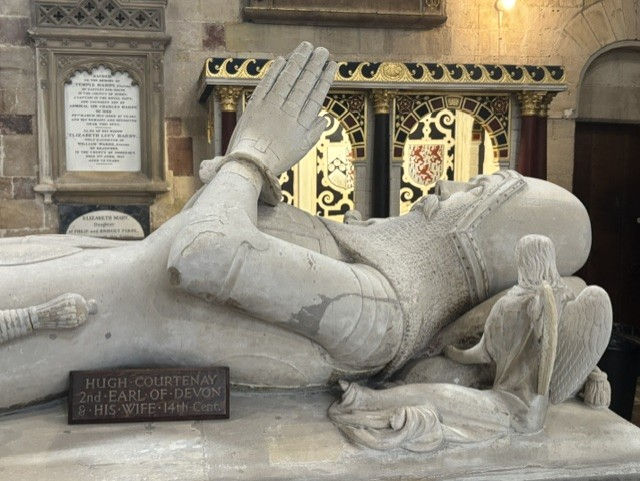
Curiously, the opposite proved true on my mother's side. As I pushed further back through the centuries, several maternal and paternal branches entered families that had left an unusually rich historical record in the 12th to 16th centuries, and whose names can be found in European history books. One of them is the Courtenay family, which originated in France and intersects many branches of medieval European aristocracy in German, France, England, Scotland, Ireland and Hungary.
As my research continued, a much bigger picture began to emerge. My family history turned out to be one of constant migration. French ancestors moved from the Yonne region into Germany during the eighteenth century. Finnish families migrated through Sweden and Estonia before settling in northern Germany. English ancestors crossed the Atlantic to Virginia, Connecticut, and Massachusetts centuries before one of their descendants eventually found his way back to Europe—and, somehow and somewhere, amidst the turmoil of the First World War, met my German great-grandmother. No recorded marriage or fatherhood. But DNA doesn't lie. That's a hard fact.
On my father's side, a completely different picture emerged: one of stability, of continuity. The family settled in East Prussia as early as the thirteenth century after migrating from the Netherlands and Rhineland-Palatinate, where some ancestors were recorded as knights.
The research also taught me that family names evolve just as families do. Regnard became Renard, Herminger became Hermigier and later Heermeyer, while Bigge eventually became Biggs. Small changes like these often became important clues in solving much larger genealogical puzzles.
Close to ten years after I took over from my uncle, my family tree now contains more than 25,000 people, including approximately 8,000 direct ancestors. My deepest documented lineages stretch from Germany into medieval Armenia before branching towards northern India and along the ancient Silk Road into China. What I once assumed was a largely German family has become a remarkable mosaic of German, Dutch, English, French, Finnish, Swedish, Estonian, Lithuanian, Belarusian, Scottish, Welsh and many other ancestral origins.
Some discoveries still make me smile. One unexpected line led to Athon de Courtenay, founder of the medieval Courtenay family of France and later Devon in England. That documented lineage later qualified me for membership of the Courtenay Society at Powderham Castle in Devon, where I visited with my son in late 2025. It's a pleasing reminder that family history sometimes leads to unexpected places. Once a year I am now invited to a get-together with the Earl of Devon, a distant cousin of mine, at stunning Powderham Castle in England. I visited together with my son in 2025 and we were amazed by the history on display in the castle - history that connects directly to him and me as direct descendants of some of the people who once inhabited it.
Other discoveries were more thought-provoking. I found direct ancestors fighting on opposite sides of medieval wars, while others unknowingly carried their family lines across continents before eventually converging in Germany. And perhaps most touching of all was discovering that, although my maternal grandfather never knew his American father, they nevertheless shared remarkable talents and interests. Genetics had quietly passed on much more than physical characteristics.
Perhaps the greatest lesson genealogy has taught me is this: if just one of those 8,000 direct ancestors had not survived, had chosen a different partner, or had never had children, I would not exist. Every one of them, whether famous or forgotten, wealthy or poor, was indispensable.
Genealogy has taught me far more than names and dates. It has shown me that every family is the product of countless journeys, migrations, coincidences, hardships, and choices stretching across hundreds of years. My own family is no exception—and that, more than anything else, is what continues to fascinate me.


A typical chromosome painting representative of Germanic roots, showing North Sea/Baltic (yellow) and Caucasus (green) DNA signals
A chromosome painting showing DNA segments associated with Native American ancestry. These segments are often accompanied by signals classified as Asian (orange), Siberian (bright green), and Oceanian (olive), reflecting the ancestral populations involved in the migration of the first peoples into the Americas via the Bering Land Bridge from Siberia.
_gif.gif)
Comparison of DNA with ancient DNA samples recovered through archaeology. (Click to enlarge.) In this example, the tester shows genetic matches to the Clovis and Kennewick specimens, two ancient individuals from North America associated with the earliest Native American populations. The tester also shares DNA with numerous ancient individuals from archaeological sites in present-day Hungary, Germany, Ireland, and England.
Map showing the migration pathways of Daniel's ancestors between the 18th and 20th century. The blue lines represent his paternal side, the red ones his maternal side.

Advanced analysis of DNA origins for the Northwestern Europe region using Genomelink, providing a more detailed picture of ancestral origins and geographic connections.

3D chromosome browser to investigate DNA match triangulations between a group of 8 persons with roots to the Stewart family in Scotland

My son at the Mayflower Steps in Plymouth UK, 2025
Sarcopahgus of Hugh de Courteney at Powderham Castle. He was my 19th grandfather on my mother's side.
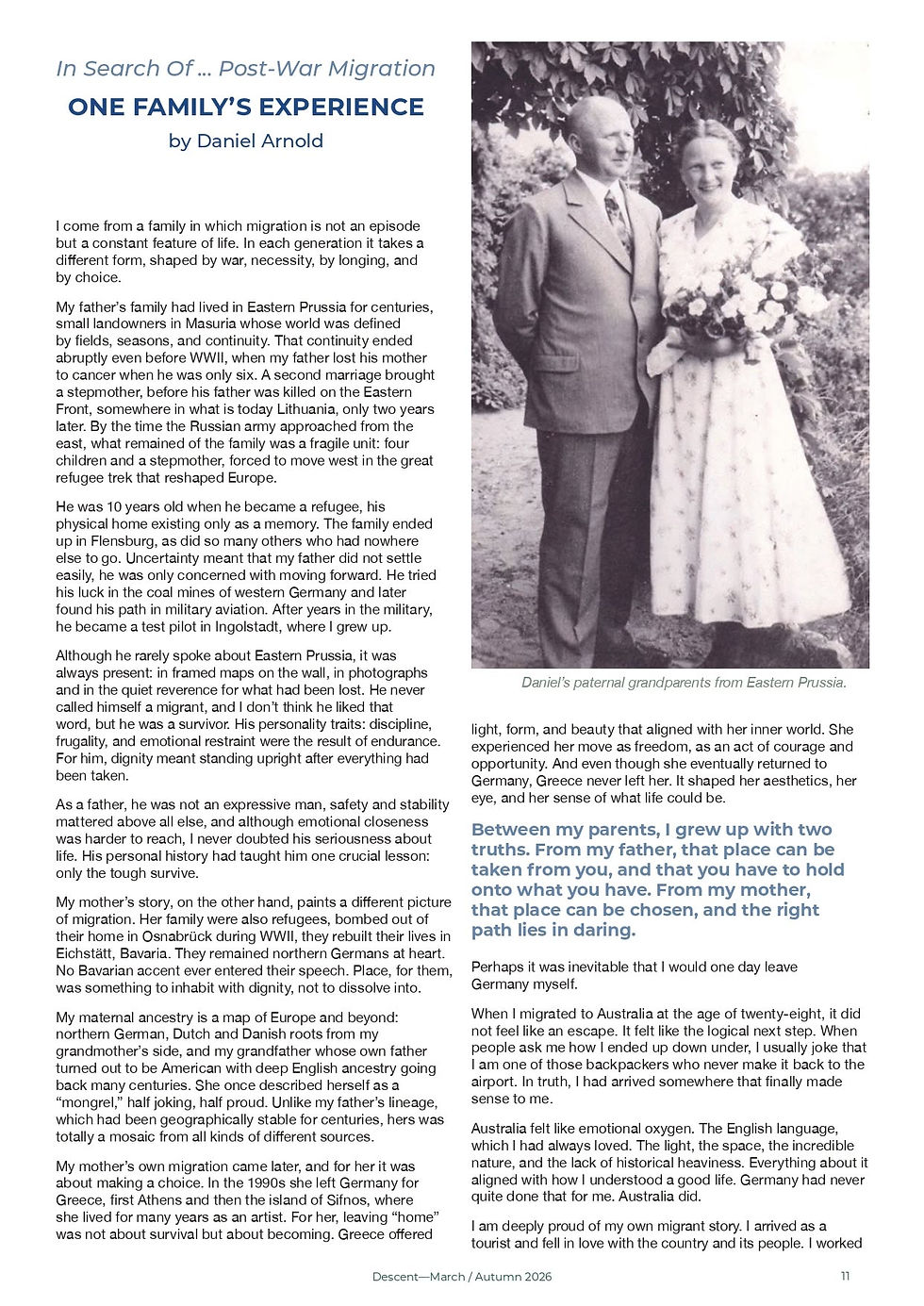
Article by Daniel Arnold on the topic of Migration
published by the Australian Society of Genealogists
in the quarterly magazine "Descent" 1/2026
(click on the image to open a pop-up or here to open as PDF)

.jpg)
CAMPAIGN NAME
EXPERIENCED RESULTS
DRIVEN LEADERSHIP
2035